Boosting Manufacturing Efficiency: A Practical Guide to Modern Sandwich Panel Production Lines
Manufacturing efficiency is becoming increasingly important as sandwich panel producers face pressure to control costs, shorten delivery times, and maintain consistent product quality. A modern sandwich panel production line can address these challenges by connecting material feeding, roll forming, insulation-core processing, bonding, cutting, and stacking into a coordinated workflow. Instead of improving only one machine, manufacturers can optimize the entire production process for higher usable output and lower waste.
For companies planning an automation upgrade, the right solution is therefore not necessarily the fastest sandwich panel machine. The more important question is whether the complete line can match product requirements, production capacity, and material characteristics while keeping the process stable.
Why Production Efficiency Determines Manufacturing Profitability
Production efficiency has a direct effect on manufacturing costs. Every unnecessary material transfer, manual adjustment, production stoppage, or rejected panel adds cost without increasing saleable output. When several individual machines operate independently, differences in processing speed can also create bottlenecks between forming, core preparation, lamination, and cutting.
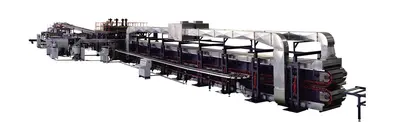
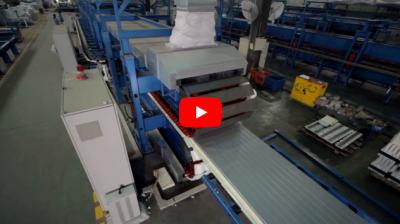
A continuous sandwich panel production line helps reduce these interruptions by linking multiple operations into one production sequence. Depending on the configuration, manufacturers can integrate decoiling, film coating, roll forming, preheating, foaming or core feeding, laminating, curing, cutting, cooling, and stacking.
The advantage is not simply faster production. A synchronized process can also provide more consistent panel dimensions, bonding quality, and insulation-core distribution. For high-volume manufacturers, improving the stability of each stage can increase effective output while reducing material loss.
Core Equipment in a Modern Sandwich Panel Production Line
The equipment configuration depends on the panel structure and insulation material, but a complete production system generally combines several key sections:
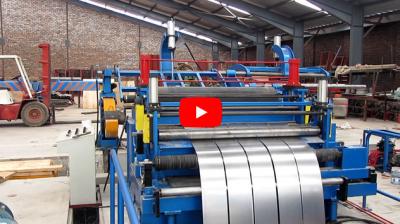
Decoiling and roll forming: Metal coils are unwound and shaped into the required roof or wall profile. Stable feeding and accurate forming are important for maintaining panel dimensions.
Core processing: PU/PIR panels require controlled foaming and curing, while EPS and rock wool panels use dedicated feeding and positioning systems.
Laminating and pressing: The core is bonded between the outer metal sheets, with controlled pressure helping achieve consistent thickness and adhesion.
Cutting and finishing: Automated cutting, cooling, and stacking prepare finished panels for storage, packaging, or further handling.
Jinggong currently provides PU/PIR, rock wool, and EPS solutions, demonstrating how sandwich panel machinery needs to be configured according to the core material rather than treated as a universal system. Its PU/PIR line, for example, integrates decoiling, roll forming, preheating, foaming, solidification, cutting, cooling, stacking, and packing.
Automation Strategies That Reduce Material Waste
Automation has its greatest impact when different stages of production need to operate continuously and at synchronized speeds. If material feeding, forming, lamination, and cutting are not coordinated, small deviations can quickly become significant waste during long production runs.
A modern sandwich panel line can use centralized control systems to coordinate production parameters and reduce unnecessary operator intervention. Jinggong's equipment uses integrated control and linkage systems that centralize control points, support parameter coordination, and provide fault self-diagnosis.
Several automation strategies can contribute directly to efficiency:
Synchronized material flow: Coordinating feeding, forming, and laminating reduces interruptions and misalignment.
Automatic cutting: Precise length control helps minimize errors caused by manual measurement and reduces unnecessary scrap.
Centralized monitoring: Operators can observe important production parameters and respond to abnormal conditions earlier.
Automatic stacking: Systematic handling reduces labor requirements and lowers the risk of finished-panel damage.
Jinggong's rock wool production line, for example, combines digital servo technology, frequency conversion, hydraulic control, and automatic stacking. Its published production speed is 3–8 m/min depending on product requirements, while the company states that the line can reach an annual capacity of up to 800,000 m² under specified operating conditions.
Automation therefore should not be evaluated only by the number of automated functions. The more useful question is whether the control system improves synchronization between production stages and reduces the causes of downtime and material waste.
Choosing the Right Line for Different Sandwich Panel Types
A suitable sandwich panel production line should be selected according to the intended product range, not simply according to nominal machine speed. Different insulation materials require different processing methods and equipment configurations.
| Panel Type | Core Material | Main Process Requirement | Typical Equipment Focus |
|---|
| PU/PIR | Polyurethane / PIR foam | Foaming, curing, and continuous lamination | Foaming system, preheating, double-belt system |
| Rock Wool | Mineral wool | Core feeding, adhesive application, and pressing | Rock wool system, glue spraying, laminating |
| EPS | Expanded polystyrene | Core feeding, gluing, and lamination | EPS feeding, glue system, laminator |
PU/PIR systems require accurate control of chemical reaction, temperature, and curing. Rock wool production places greater emphasis on core positioning, adhesive distribution, and compression, while EPS production requires stable core feeding and lamination.
Jinggong's published PU/PIR specifications include panel widths of 600–1,200 mm and panel thicknesses of 30–200 mm under the specified configuration, with an adjustable production speed of 3–8 m/min. Its EPS solution integrates a roll forming machine with a laminating system, while the rock wool line uses dedicated rock wool feeding and adhesive systems.
Manufacturers should also consider whether the line can support future product expansion. A flexible sandwich panel machine configuration may allow producers to adjust panel dimensions, profiles, and core materials as market demand changes.
Why Jinggong Helps Manufacturers Scale Efficiently
Jinggong focuses on integrated building-material equipment and currently offers PU/PIR continuous, rock wool continuous, and EPS sandwich panel production solutions. This product range allows manufacturers to select equipment according to insulation-core characteristics, panel specifications, and production targets.
The value of an integrated system becomes particularly clear when manufacturers move from small-volume production to larger-scale manufacturing. Instead of adding disconnected machines that require additional material handling and operators, a properly configured line can connect forming, core processing, bonding, cutting, and stacking within one coordinated workflow.
Jinggong's PU/PIR line is designed for automatic processing from uncoiling through packing, with a published maximum production speed of up to 12 m/min and an annual output of up to 1 million m² under specified conditions. These figures should be evaluated alongside actual panel specifications and production requirements rather than treated as universal production guarantees.
For manufacturers, the long-term benefit of automation is therefore broader than higher speed. Better synchronization can improve material utilization, reduce manual handling, stabilize product quality, and make capacity expansion more predictable.
Ultimately, a modern sandwich panel production line should be viewed as a complete manufacturing system rather than a collection of individual machines. By matching sandwich panel machinery to the core material, product specifications, and desired capacity, manufacturers can build a more efficient production process today while creating room for future growth. Jinggong's range of PU/PIR, rock wool, and EPS solutions provides a practical foundation for manufacturers seeking to improve efficiency and scale production with a coordinated sandwich panel line.

 CN
CN
 EN
EN
 fr
fr  de
de  es
es  it
it  ru
ru  pt
pt  ar
ar  th
th  pl
pl  ro
ro 

 Call us on:
  Email Us:
  #1809, Jianhu Rd, Keqiao, Shaoxing, Zhejiang, China