PU vs PIR Sandwich Panel Production Line: Differences in Material, Process and Applications
Choosing between PU and PIR panel production depends on fire performance, thermal insulation, target applications, local standards, and chemical-processing capability. A PU/PIR sandwich panel uses polyurethane-based chemistry, but the two foam systems are not identical. PIR generally contains a higher proportion of isocyanate and forms a more thermally stable structure during reaction.
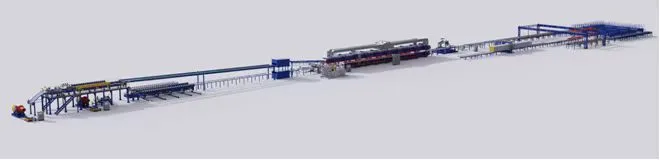
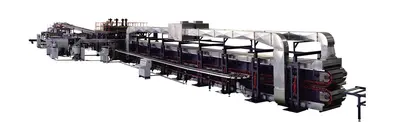
The PIR sandwich panel full form is polyisocyanurate sandwich panel. PU means polyurethane. Both types combine metal facings with a rigid foam core and can be produced on a continuous line integrating sheet forming, preheating, chemical metering, foaming, curing, cutting, and stacking. The line should be configured around the intended formulation rather than assuming every PU line can switch to PIR without adjustment.
What Is the Practical Difference Between PU and PIR Panels?
PU panels are widely used where efficient insulation, low weight, and broad cost performance matter. PIR panels are selected when a project requires improved reaction-to-fire performance or greater thermal stability.
The main comparison is:
Core chemistry: PU uses polyurethane; PIR uses a modified polyisocyanurate structure.
Thermal performance: both insulate well when density and cell structure are controlled.
Fire behavior: PIR is generally formulated for better fire performance.
Processing: PIR requires tighter control of formulation, temperature, mixing, and curing.
Applications: PU is common in cold rooms; PIR is often specified for higher-performance wall and roof systems.
Actual performance still depends on formulation, density, facings, joints, workmanship, and testing. Material names alone do not guarantee compliance with a particular building code or fire classification.
How the Production Process Changes From PU to PIR
A PU sandwich panel production line and a PIR-capable line share the same overall layout, but the chemical section and process settings require careful review. The supplier must understand the raw-material system and provide suitable metering ratios, mixing, temperature control, injection distribution, and curing conditions.
Key control points in PIR production include:
Stable storage temperatures
Accurate ratio control
Consistent mixing across the panel width
Correct sheet and laminator preheating
Sufficient curing time
Monitoring of density, adhesion, and dimensional stability
PIR reactions may demand a different process window from standard PU. If the line runs too fast or temperatures are unstable, panels may show poor bonding, uneven density, surface defects, or incomplete curing. Buyers should confirm the chemical supplier’s requirements and how the machinery translates them into operating recipes.
Can One Machine Produce Both PU and PIR Panels?
A flexible PIR sandwich panel machine may produce both materials, but compatibility must be confirmed. Mechanical sections can often be shared. The main questions concern chemical storage, metering, mixing, cleaning, temperature management, and recipes.
Buyers should ask:
Can the metering unit handle the required ratios?
Are tanks, pumps, pipes, and mixers compatible?
How are recipes stored and protected?
What cleaning or changeover procedure is required?
Can the laminator provide enough curing time?
What tests approve the first production batch?
A line described as “PU/PIR compatible” should have a clear configuration and operating method. Verify the formulation range, previous projects, and commissioning plan instead of relying only on a product label.
Applications and Market Positioning
PU and PIR panels can serve overlapping markets, but manufacturers often position them differently. PU is practical for cold storage, refrigerated warehouses, modular buildings, insulated doors, and general industrial enclosures. PIR is commonly promoted for industrial roofs, external walls, logistics buildings, and projects emphasizing fire performance.
When studying the difference between PUF and PIR panels, manufacturers should consider what customers specify. Cold-room contractors may value insulation efficiency, hygienic joints, and rapid delivery. Industrial-building customers may place more weight on tested fire performance, roof and wall profiles, long panels, and installation productivity.
The production strategy should begin with:
This information helps determine whether the factory should focus on PU, PIR, or a flexible portfolio.
How to Select a PU/PIR Production Line
The right line should maintain accurate chemical metering, uniform foam distribution, stable curing, panel flatness, dimensional accuracy, and repeatable output. Buyers should compare more than nominal speed.
Important evaluation points include:
Experience with PU and PIR formulations
Configuration of tanks, pumps, mixers, and injection systems
Length and temperature control of the laminator
Profile-change and thickness-adjustment methods
Control recipes and production data
Cutting, cooling, stacking, and packing
Installation and trial-production support
The supplier should explain which products have been made on comparable equipment. Reference projects are especially useful for PIR because successful production depends on coordinated machinery, chemistry, and operating discipline.
FAQ About PU vs PIR Sandwich Panel Production
What is the PIR sandwich panel full form?
PIR stands for polyisocyanurate. A PIR sandwich panel uses a rigid polyisocyanurate-based foam core between protective facings.
Is PIR always better than PU?
No. PIR may provide improved fire performance, while PU can be cost-effective and suitable for cold rooms and general insulation.
Can the same continuous line make both products?
It may, provided the chemical system, metering equipment, temperature control, laminator, and recipes are designed for both formulations.
What should be tested during commissioning?
Check foam density, adhesion, panel thickness, surface flatness, dimensional stability, cutting accuracy, and production repeatability.
What should a buyer provide to the supplier?
Provide the intended formulation, applications, widths, thicknesses, profiles, output target, local standards, workshop layout, and utilities.
Jinggong provides PU/PIR continuous sandwich panel production solutions connecting sheet forming, chemical processing, curing, cutting, cooling, stacking, and packing. Submit your product range and formulation requirements for a project-specific configuration.

 CN
CN
 EN
EN
 fr
fr  de
de  es
es  it
it  ru
ru  pt
pt  ar
ar  th
th  pl
pl  ro
ro 

 Call us on:
  Email Us:
  #1809, Jianhu Rd, Keqiao, Shaoxing, Zhejiang, China