Rockwool Sandwich Panel Specification and Key Parameters
Rockwool sandwich panels are widely recognized as one of the most reliable building materials for fire-resistant, energy-efficient, and sound-insulated structures. From industrial factories and warehouses to data centers and commercial buildings, these panels are specified in projects where fire safety and durability are critical.
However, understanding rock wool sandwich panel specifications goes beyond simply knowing thickness or density. These parameters directly influence not only the panel’s performance but also how it is manufactured. In fact, every specification requirement places specific demands on the sandwich panel production line.
Rockwool Sandwich Panel
A rockwool sandwich panel is a composite building element consisting of:
Two outer metal sheets (typically pre-painted galvanized steel or aluminum)
A core made from rockwool (mineral wool derived from basalt or natural stone)
Adhesive bonding or mechanical integration
Rockwool is an inorganic, non-combustible material that offers excellent fire resistance, thermal insulation, and acoustic performance.
These panels are widely used in:
Industrial buildings and warehouses
Cleanrooms and pharmaceutical facilities
Cold storage and food processing plants
Commercial and public buildings
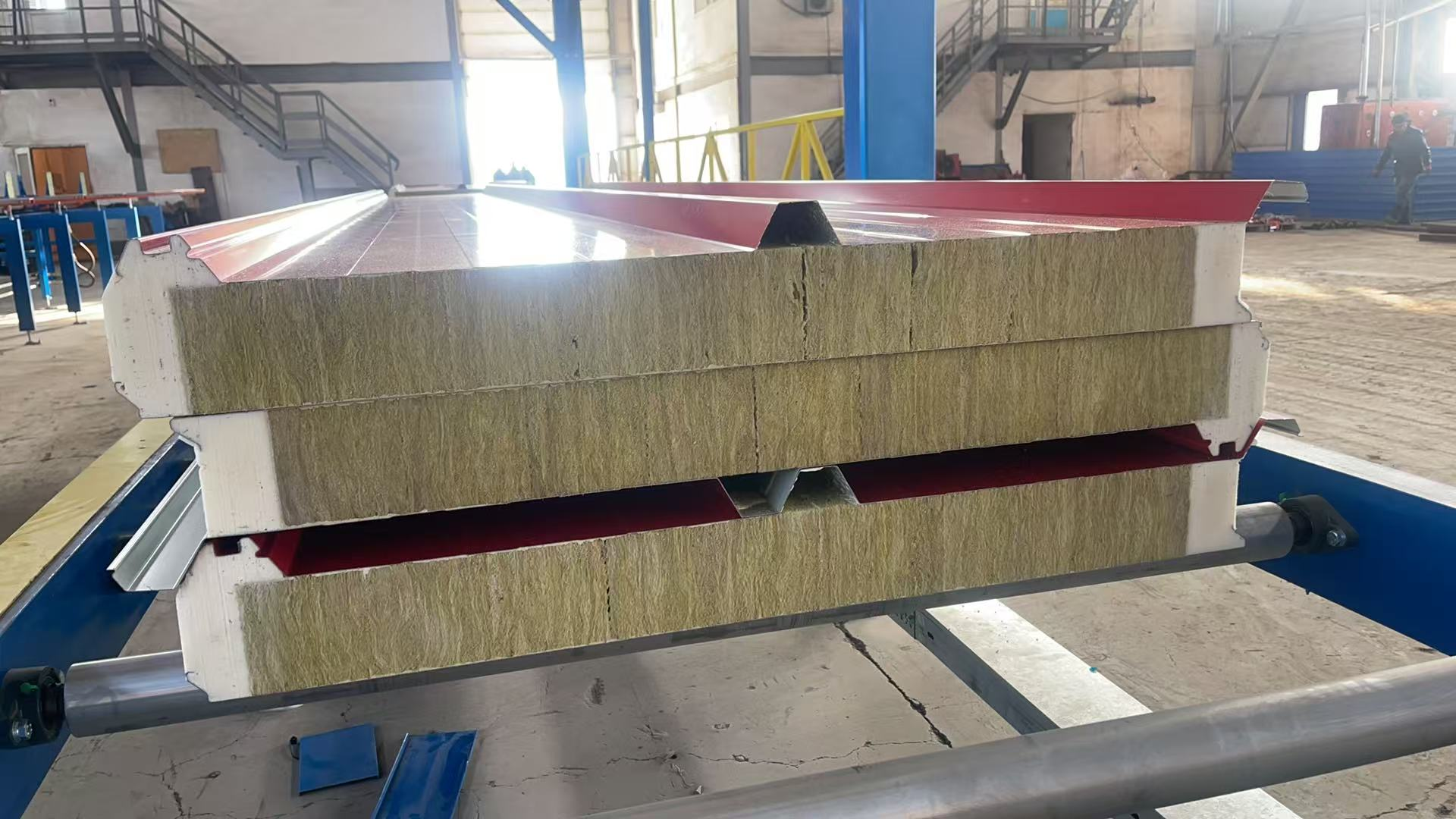
Core Specifications of Rockwool Sandwich Panels
Understanding the specifications is essential for selecting the right panel for your application.
1. Panel Thickness
Panel thickness is one of the most critical parameters because it affects fire resistance, thermal insulation and structural strength.
Typical thickness ranges include:
50 mm
75 mm
100 mm
150 mm
200 mm
In fire-rated applications, thickness is directly linked to fire resistance duration. For example:
60 mm panels can achieve REI 30
100 mm panels can achieve REI 90
150 mm panels can reach REI 180
This means that selecting panel thickness is not just a design choice, often dictated by building codes and safety requirements.
2. Core Density
The density of the rockwool core significantly influences performance:
Typical density range: 100–150 kg/m³
Higher density improves fire resistance , mechanical strength and acoustic insulation
However, higher density also increases panel weight, which impacts transportation and installation.
3. Fire Resistance Rating
Rockwool sandwich panels are known for their exceptional fire performance:
Fire classification: Class A1 (non-combustible)
Fire resistance duration: Typically 1.5 to 3 hours, depending on thickness; can reach up to 4 hours in optimized designs
Unlike organic core materials, rockwool does not burn, release toxic gases, or contribute to flame spread.
4. Metal Facing Specifications
The outer layers of the panel also play a key role:
Material: Pre-painted galvanized steel, aluminum, or stainless steel
Thickness: Typically 0.3 mm to 1.0 mm
Surface coatings: PE, SMP, HDP, PVDF coatings for corrosion resistance
These facings provide structural rigidity, weather resistance, and aesthetic appearance.
5. Panel Width and Dimensions
Standard panel dimensions include:
Effective width: 950 mm, 1000 mm, 1150 mm
Length: Customizable depending on project requirements
Standardization ensures compatibility with building systems and simplifies installation.
6. Thermal and Acoustic Performance
Rockwool sandwich panels deliver strong insulation properties:
These properties make them ideal for energy-efficient buildings and noise-sensitive environments.
Summary
Parameter | Typical Range |
Thickness | 50–200 mm |
Core Density | 100–150 kg/m³ |
Steel Thickness | 0.4–0.8 mm |
Fire Rating | Class A1 |
Fire Resistance | 1.5–4 hours |
Thermal Conductivity | ~0.041 W/m·K |
Width | 950–1150 mm |
Specifications in Real Projects
Each specification is tied to real-world performance:
Higher density: better fire and acoustic performance
Greater thickness: higher insulation and fire resistance
Stronger facings: improved structural durability
For example: data centers require high fire resistance; cold storage facilities need precise thermal insulation; industrial plants demand both fire safety and durability.
As building standards become stricter globally, the demand for high-spec rockwool sandwich panels continues to rise.While specifications define the performance of rockwool panels, they also determine how these panels must be manufactured.
Producing a high-quality rockwool sandwich panel requires:
Precise control of core density
Accurate placement of rockwool fibers
Uniform bonding between core and metal facings
Consistent panel thickness across large volumes
These requirements cannot be met through manual or low-end processes. Instead, they rely on advanced sandwich panel production lines.
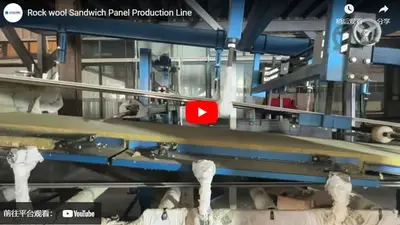
Rockwool Sandwich Panels Manufacturing
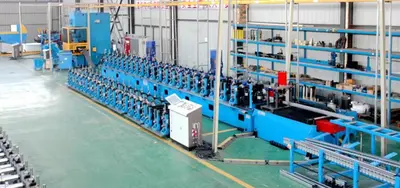
1. Steel Coil Feeding and Profiling
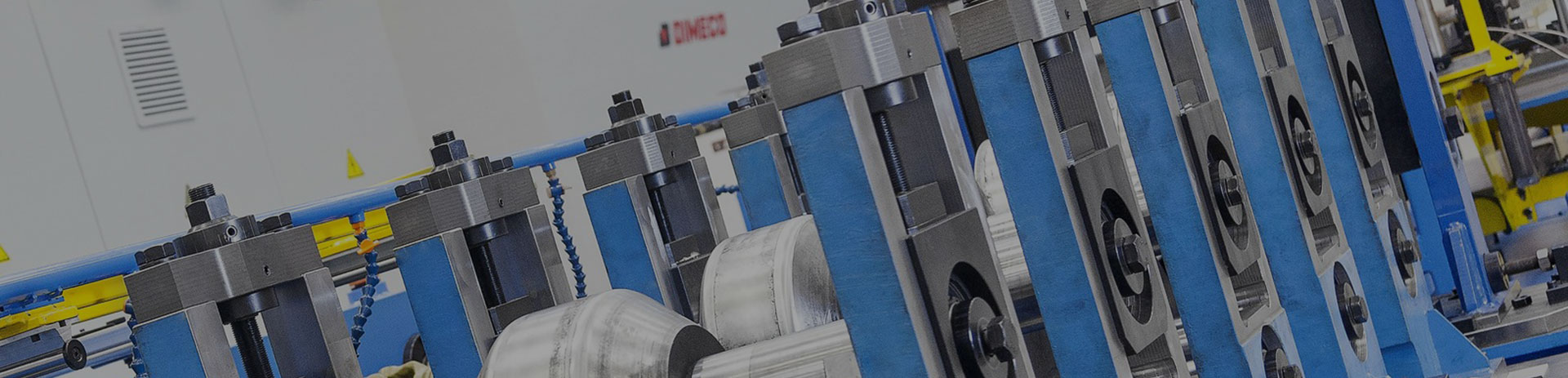
Metal sheets are uncoiled and shaped using roll forming machines.
2. Rockwool Core Preparation
Rockwool slabs or fibers are cut and arranged to achieve the required density and orientation.
3. Panel Assembly
The core is placed between metal sheets, and adhesive systems ensure bonding.
4. Continuous Pressing and Bonding
Panels pass through a double belt press system where pressure and temperature ensure proper bonding.
5. Cutting and Finishing
Panels are cut to size and prepared for delivery.
How Jinggong Supports High-Spec Rockwool Panel Production?
To meet the growing demand for high-performance rockwool panels, manufacturers require reliable and advanced production solutions. Jinggong rock wool lines are designed to meet these challenges by offering:
1. Precise Core Handling Systems
Ensuring consistent rockwool density and distribution across the panel.
2. Advanced Double Belt Press Technology
Providing uniform pressure and bonding, critical for fire-rated panels.
3. Flexible Production Capabilities
Supporting different panel thicknesses and specifications (50–200 mm and beyond).
4. High Automation and Control
Using PLC systems to maintain consistency, reduce errors, and improve efficiency.
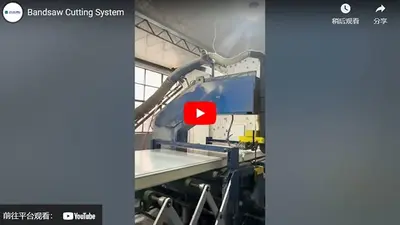
5. Integrated Cutting and Stacking Systems
Enhancing productivity and minimizing damage during handling.
With these capabilities, Jinggong enables manufacturers to produce rockwool sandwich panels that meet strict international standards while maintaining high efficiency.
Higher Specifications, Smarter Production
The construction industry is evolving toward:
Stricter fire safety regulations
Higher energy efficiency requirements
Increased adoption of prefabricated buildings
As a result, rockwool sandwich panel specifications are becoming more demanding higher density cores, thicker panels and better fire ratings, improving acoustic performance. At the same time, production lines are becoming more advanced, incorporating digital monitoring systems, automated quality control and energy-efficient processes. Manufacturers who invest in modern production lines will be better equipped to meet these future demands.
Rockwool sandwich panel specifications, such as thickness, density, fire rating, and thermal performance, define the panel’s role in modern construction. These parametersare closely linked to manufacturing capabilities.Producing high-quality rockwool panels requires advanced sandwich panel production lines that can ensure precision, consistency, and efficiency. By leveraging technologies like those offered by Jinggong, manufacturers can meet strict specification requirements, improve production efficiency and reduce costs and material waste.
Ultimately, the connection between panel specification and production technology is the key to delivering high-performance building solutions in today’s construction industry.

 CN
CN
 EN
EN
 fr
fr  de
de  es
es  it
it  ru
ru  pt
pt  ar
ar  th
th  pl
pl  ro
ro 

 Call us on:
  Email Us:
  #1809, Jianhu Rd, Keqiao, Shaoxing, Zhejiang, China