Rock Wool Sandwich Panel Lines: What Buyers Should Know Before Investing
Choosing production equipment for insulated building panels is a long-term decision. For manufacturers considering fire-resistant and thermally insulating products, a rock wool sandwich panel line needs to deliver more than basic panel assembly. The line must handle rock wool feeding, adhesive application, panel forming, lamination, cutting and stacking while maintaining stable product dimensions and bonding quality.
For buyers comparing a rock wool sandwich panel production line, the key question is therefore not simply how fast the equipment can run. Material compatibility, automation, production capacity, panel specifications, maintenance requirements and long-term operating stability should all be evaluated before investment.
Why Rock Wool Panels Continue to Gain Market Demand
Rock wool sandwich panels combine metal facing sheets with a mineral wool core. The core provides thermal insulation and contributes to fire-resistant construction, making these panels relevant to industrial buildings, warehouses, workshops, commercial facilities and other projects where thermal and fire performance are important.
Compared with conventional insulation materials, rock wool also presents different processing requirements. The core is relatively dense and fibrous, so stable feeding and accurate positioning are essential during continuous production. Adhesive must be distributed consistently to achieve reliable bonding between the core and metal surfaces.
For manufacturers, this creates an opportunity as well as a production challenge. Demand for insulated building materials is closely connected with construction efficiency and energy performance, but producing consistent rock wool panels requires equipment designed specifically around the material.
A dedicated rock wool line can integrate multiple operations into a continuous workflow, reducing manual handling while improving process consistency.
Essential Equipment in a Rock Wool Sandwich Panel Line
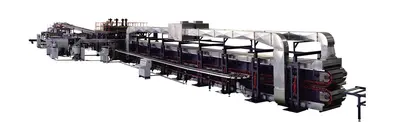
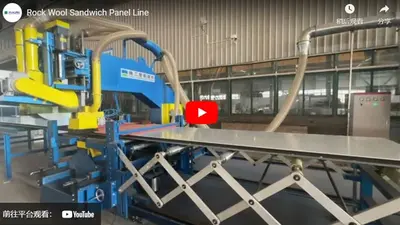
A complete production system generally connects several stages rather than relying on individual machines. The exact configuration depends on panel thickness, width, rock wool density, adhesive requirements and expected output.
Key sections normally include:
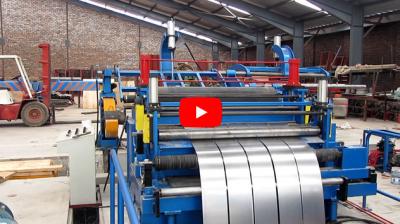
Feeding and forming: Metal coils are decoiled, guided and roll formed into the required panel profile. Stable feeding helps maintain alignment throughout production.
Rock wool processing: Rock wool boards or strips are automatically conveyed and positioned according to the required panel dimensions.
Adhesive application: Controlled adhesive spraying or application helps create a consistent bonding layer between the insulation core and metal sheets.
Lamination and pressing: The assembled materials pass through a pressing system to establish the required panel thickness and bonding quality.
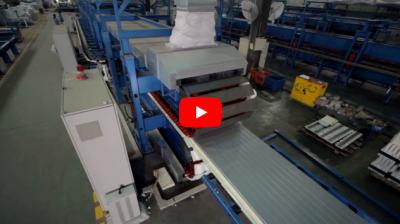
Cutting and stacking: Continuous panels are cut to specified lengths and transferred to stacking equipment for organized handling.
The integration of these stages is one of the main differences between a complete sandwich panel production line and a collection of standalone machines. When feeding, forming, adhesive application and cutting are synchronized, manufacturers can reduce waiting time and improve effective production capacity.
Production Challenges and Practical Solutions
Rock wool has characteristics that make continuous production more demanding than some lightweight insulation materials. Its density, fibrous structure and dimensional variation can influence feeding, positioning and bonding. At the same time, the metal facings need to remain accurately aligned throughout the lamination process.
| Production Challenge | Potential Impact | Practical Equipment Approach |
|---|
| Unstable rock wool feeding | Core misalignment | Automated feeding and positioning |
| Uneven adhesive distribution | Weak or inconsistent bonding | Controlled adhesive application |
| Panel thickness variation | Dimensional inconsistency | Stable pressing and guiding |
| Sheet misalignment | Poor panel appearance | Accurate guiding and forming |
| Manual stacking | Higher labor demand | Automatic stacking and handling |
Automation can address many of these issues by reducing unnecessary operator intervention. Centralized PLC control can coordinate feeding, adhesive application, lamination, cutting and stacking, while sensors and controlled drives help maintain synchronization.
Jinggong's published rock wool continuous production line uses computer control, digital servo technology, frequency conversion and hydraulic control. The company lists a production speed of approximately 3–8 m/min under specified configurations and an annual production capacity of up to 800,000 m² under stated operating conditions. Actual output depends on panel specifications and production conditions.
Investment Considerations Before Purchasing
The initial equipment price is only one part of the investment calculation. Buyers should consider how the proposed rock wool sandwich panel line will perform over its expected operating life.
Several questions deserve attention before selecting equipment. What panel thicknesses and widths need to be produced? What rock wool density and core dimensions will be used? What production volume is expected per shift or year? Will the manufacturer produce one fixed panel profile or several specifications?
The production environment should also be considered. A line that operates effectively at a certain speed with one panel specification may have a different practical output when panel thickness, core density or cutting length changes.
Maintenance and spare-parts availability are equally important. Production downtime can have a greater financial impact than a small difference in initial equipment cost, especially for manufacturers operating continuous production schedules.
Buyers should therefore compare suppliers based on complete system capability, automation level, equipment configuration, technical support and suitability for their actual product range—not simply on a headline production speed.
Jinggong Machine's Complete Rock Wool Production Solutions
Jinggong Machine provides integrated rock wool sandwich panel production solutions designed to connect material feeding, adhesive application, lamination, cutting and stacking into a coordinated production process.
Its rock wool equipment is designed around automated control and continuous processing, helping manufacturers reduce manual handling while maintaining more stable production conditions. The company also provides other insulated panel solutions, allowing manufacturers with broader product portfolios to evaluate rock wool alongside PU/PIR and EPS production technologies.
For a buyer planning a new rock wool sandwich panel production line, this broader equipment experience can be useful when assessing how a production system should fit into an existing factory or future expansion plan.
The right equipment configuration should ultimately be based on the desired panel specifications, production capacity, material characteristics and automation requirements. A well-designed rock wool line can improve production continuity while reducing unnecessary handling and helping manufacturers maintain consistent panel quality.
For companies entering or expanding the rock wool panel market, choosing a suitable rock wool sandwich panel line is therefore a process decision as much as an equipment decision. By evaluating the complete workflow—from coil feeding and rock wool positioning to bonding, cutting and stacking—buyers can make a more informed investment and build a production system capable of supporting long-term manufacturing efficiency.

 CN
CN
 EN
EN
 fr
fr  de
de  es
es  it
it  ru
ru  pt
pt  ar
ar  th
th  pl
pl  ro
ro 

 Call us on:
  Email Us:
  #1809, Jianhu Rd, Keqiao, Shaoxing, Zhejiang, China