Rock Wool Sandwich Panel Line for Fire-Resistant Building Panel Production
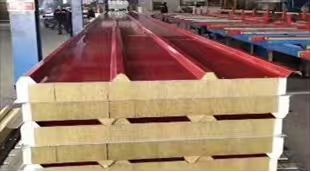
A rock wool sandwich panel line is used to manufacture fire-resistant insulated panels by bonding metal sheets with a rockwool or mineral wool core through continuous forming, pressing, cutting, and stacking. These panels are widely used in factories, warehouses, logistics centers, commercial buildings, power facilities, and prefabricated construction projects.
Jinggong’s rockwool continuous sandwich panel production line is described as a continuous automatic line integrating mechanical systems, electrical control, hydraulic systems, roll forming technology, digital servo technology, frequency conversion vector technology, and automatic stacking technology. Its official product page states that the production speed is adjustable from 3-8 m/min according to product forming requirements.
What Buyers Mean by Fire-Resistant Panel Production?
When buyers search for a rock wool sandwich panel line, they are usually not looking for a simple definition of rockwool. They want to know whether the equipment can help them supply real fire-resistant building projects with stable quality and predictable delivery.
Rockwool sandwich panels are commonly used in:
Industrial wall systems
Warehouse enclosure systems
Fire-resistant partition walls
Factory roof and wall panels
Logistics building panels
Commercial building envelopes
Prefabricated construction projects
In these projects, buyers care about more than production output. They need reliable bonding, accurate panel dimensions, clean edges, stable surface quality, and consistent delivery schedules. The production line should therefore be presented as a project-supply system, not only as panel manufacturing equipment.
Why Rockwool Core Handling Is the Main Quality Challenge?
The rockwool core is the main quality challenge in this type of panel production. Unlike PU or PIR panels, where the core is formed through foaming, rockwool panels depend on accurate handling of fibrous insulation boards.
The core needs to be cut, arranged, transferred, aligned, bonded, pressed, and combined with metal surface sheets. If the handling process is unstable, the final panel may have uneven internal support, poor bonding, edge gaps, thickness inconsistency, or visible surface defects.
This is why the rockwool handling section should be a key concern for equipment buyers. A production line that cannot manage the core material consistently may create quality problems even when the metal sheet and rockwool material are acceptable.
For manufacturers planning to build fire-resistant panel capacity, Jinggong’s rockwool sandwich panel production line helps connect core handling, forming, bonding, pressing, cutting, stacking, and packing into one coordinated process.
How Bonding Stability Reduces Project Risk?
Bonding quality determines whether the surface sheets and rockwool core work together as one reliable panel structure. Poor bonding may lead to delamination, uneven surfaces, edge separation, or installation complaints after shipment.
For project-based construction, these problems are costly. A contractor may need to replace panels, adjust installation plans, or delay work on site. For the manufacturer, this can damage reputation and reduce repeat orders.
Bonding stability depends on several connected factors, including metal sheet surface condition, rockwool consistency, adhesive distribution, production speed, pressing control, curing conditions, cutting, and stacking. Because these factors work together, buyers should evaluate the full production line instead of focusing on one isolated machine section.
Why Dimensional Accuracy Matters for Contractors?
Rockwool sandwich panels are often installed across large wall or roof areas. If panel length, width, thickness, or edge form is inconsistent, contractors may need extra cutting or adjustment on site. This slows down installation and may create visible gaps or joint problems.
Dimensional accuracy helps contractors install panels faster and with fewer problems. It also improves the final appearance of the building envelope. For warehouses, factories, and industrial projects, this can make a meaningful difference in construction efficiency.
A reliable rockwool sandwich panel production line should help the manufacturer control forming, pressing, cutting, and stacking so that finished panels are easier to install and easier for project owners to accept.
How Automation Supports Repeatable Panel Quality?
Rockwool sandwich panel production includes many connected steps. If too much of the process depends on manual handling, quality may vary between operators, shifts, and batches. Automation helps reduce this variation and makes production easier to manage.
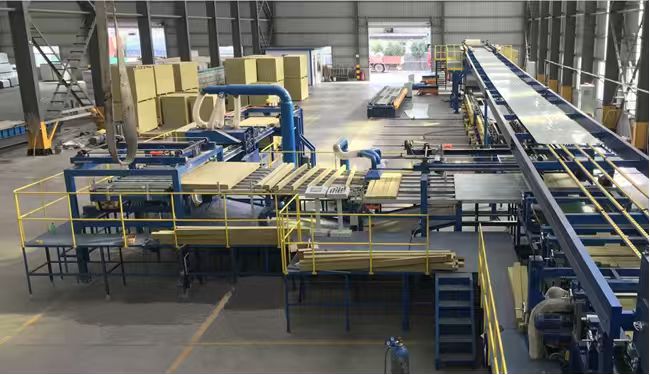
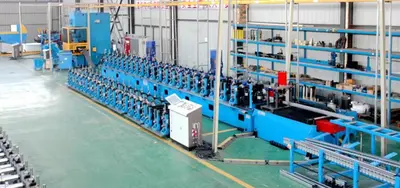
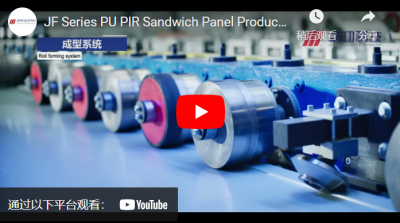
Jinggong’s rockwool line includes sections such as coiler system, filming, cutting and slitting device, roll forming system, preheating device, rockwool system, adhesive spraying system, PU side seal foaming machine, double belt system, bandsaw system, stacker system, and packing system.
Automation helps manufacturers improve:
Core placement consistency
Adhesive application stability
Cutting accuracy
Production rhythm
Stacking quality
Labor efficiency
Batch-to-batch repeatability
For buyers, repeatability is often more important than short-term speed. A factory that can maintain stable quality across repeat orders is more competitive in project-based markets.
How Jinggong Supports Rockwool Panel Manufacturing?
Jinggong’s rockwool production solution can be positioned as a complete solution for manufacturers that need stable rockwool panel output. The line connects core handling, forming, adhesive spraying, side sealing, pressing, cutting, stacking, and packing into one coordinated process.
For buyers, this matters because a rockwool panel business depends on the stability of the entire production process. A single strong machine section cannot compensate for poor line coordination. The final product depends on how well the full line manages material movement, bonding, forming, cutting, and packaging.
A rock wool sandwich panel line is a strategic investment for manufacturers targeting fire-resistant and insulated building panel markets. Its value lies in rockwool core handling, bonding stability, dimensional accuracy, automation, and project supply capability. For factories serving industrial buildings, warehouses, logistics centers, commercial facilities, and prefabricated projects, a reliable continuous line can help improve both product consistency and market credibility.

 CN
CN
 EN
EN
 fr
fr  de
de  es
es  it
it  ru
ru  pt
pt  ar
ar  th
th  pl
pl  ro
ro 

 Call us on:
  Email Us:
  #1809, Jianhu Rd, Keqiao, Shaoxing, Zhejiang, China