PU Sandwich Panel Production Line Cost Guide: Machine Configuration, Capacity and Investment Factors
The PU sandwich panel production line price is determined by capacity, panel specifications, automation, foaming accuracy, auxiliary equipment, and the services included in the quotation. Buyers should compare complete configurations rather than judge a project by one headline price.
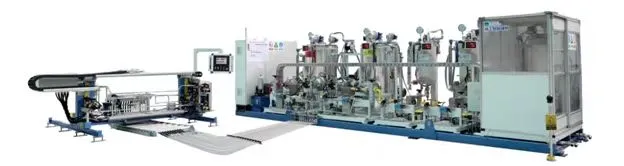
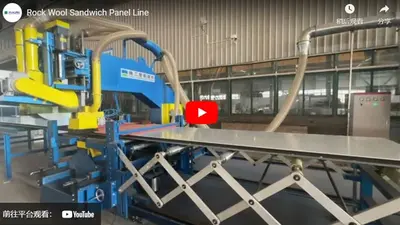
A PU sandwich panel production line forms metal facings, meters and mixes polyurethane chemicals, injects the foam, cures the panel in a double-belt laminator, cuts it to length, and transfers it for stacking and packing. For a new factory, the most economical line is the one that matches the target panel range, expected output, workshop, utilities, and operator capability without unnecessary complexity.
What Determines the Total Production Line Investment?
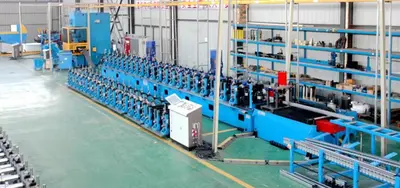
A sandwich panel production line price usually covers more than the main machine frame. The proposal may include decoilers, roll forming, sheet preheating, chemical metering, foaming equipment, a double-belt conveyor, cutting, cooling, stacking, packing, electrical control, installation, and commissioning.
The main cost drivers are:
Production speed and annual output
Panel width, thickness, profile, and joint design
PU or PIR formulation requirements
Automatic handling sections
Control-system and servo configuration
Factory voltage, layout, and safety requirements
Training and after-sales support
A useful quotation should state what is included, what is optional, and what the buyer must prepare locally. Suppliers may offer similar equipment names but different automation, component quality, commissioning support, or spare-parts coverage. Compare the complete scope line by line before deciding.
How Machine Configuration Changes the Price
The PU sandwich panel machine price rises as more steps are automated and tighter process control is required. The forming section must match the intended roof, wall, cold-room, or door profile. The foaming section must meter chemicals accurately and maintain stable temperature, pressure, and mixing. The laminator must provide controlled pressure and enough curing time.
Important sections to compare include:
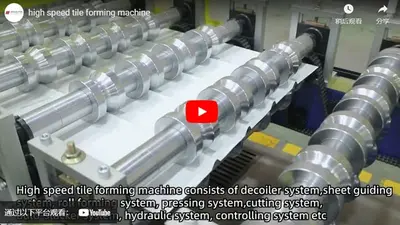
Decoiling and sheet-guiding accuracy
Roller material and profile-change method
Chemical metering and mixing precision
Double-belt length and temperature control
Cutting accuracy
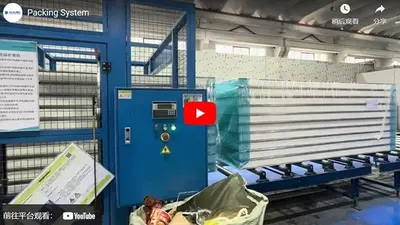
Automatic stacking and packing
PLC, drive, sensor, and electrical-component brands
A continuous PU sandwich panel production line costs more than a basic semi-automatic arrangement, but it can reduce manual variation, improve consistency, and support larger orders. Buyers should select automation that creates measurable value for their market.
How Capacity and Product Range Affect the Budget
Capacity should be selected from realistic sales and production assumptions. A high-output line may require a longer laminator, faster handling, larger chemical storage, and more powerful utilities. These additions increase investment, while an undersized line can create delivery delays.
A practical comparison is:
Developing market: prioritize flexible panel sizes and manageable automation.
Stable regional demand: balance speed, labor efficiency, and consistency.
Large project supply: prioritize continuous operation and delivery reliability.
Panel range also matters. Cold-room, industrial wall, roof, garage-door, and decorative panels may require different profiles, thicknesses, edge structures, or facings. Buyers should list the products planned for the first three years and confirm whether changes require new rollers, molds, or equipment. This avoids unused functions while keeping a reasonable expansion path.
What Costs Sit Outside the Equipment Quotation?
The PU foam manufacturing plant cost includes the line and the supporting factory infrastructure. Buyers should budget for foundations, electrical distribution, compressed air, ventilation, chemical temperature control, raw-material storage, quality inspection, forklifts, packing materials, and finished-panel storage.
Other project costs may include:
International freight and inland transport
Lifting equipment for installation
Technician travel and local labor
Trial-production chemicals and metal coils
Operator training and initial spare parts
Environmental, fire, and workplace compliance
Working capital
These items can materially change the total investment. The supplier should provide a layout and utility list early enough for site preparation. Buyers should also confirm operator requirements, consumables, and preventive maintenance after commissioning.
How to Compare Supplier Quotations and Reduce Risk
A reliable comparison starts with one technical requirement sent to every shortlisted supplier. It should specify applications, panel dimensions, profiles, metal sheets, production speed, chemical system, automation, workshop dimensions, voltage, and packing method.
Before ordering, check:
Whether the configuration matches the required panels
Whether speed is realistic under curing conditions
Which components are manufactured by the supplier
Whether installation and commissioning are included
How acceptance testing will be performed
What warranty and spare-parts service are available
Whether project references can be reviewed
A lower PU sandwich panel production line price can become expensive if the line cannot maintain foam density, panel thickness, bonding, or delivery schedules. The decision should be based on lifecycle value: stable output, acceptable material loss, manageable maintenance, operator usability, and technical support.
FAQ About PU Sandwich Panel Production Line Cost
How much does a PU sandwich panel production line cost?
There is no single standard price. The quotation depends on capacity, automation, panel range, component selection, installation scope, and factory conditions.
Why does the PU sandwich panel machine price vary?
Suppliers may use different laminator lengths, metering systems, control components, automation, and service packages. A detailed scope comparison is more useful than comparing totals.
Can one line produce several panel thicknesses?
Yes, when the laminator, guides, cutting system, and controls are designed for the required range. Profile changes may require extra tooling.
Is higher speed always better?
No. Speed must match curing time, product quality, sales demand, and downstream handling.
What should be prepared before requesting a quotation?
Provide applications, panel dimensions, profiles, metal facings, PU or PIR requirements, expected output, workshop size, voltage, and automation expectations.
Jinggong can configure a PU/PIR line around the buyer’s product range, capacity target, and factory conditions. Submit your specifications for a project-specific production solution.

 CN
CN
 EN
EN
 fr
fr  de
de  es
es  it
it  ru
ru  pt
pt  ar
ar  th
th  pl
pl  ro
ro 

 Call us on:
  Email Us:
  #1809, Jianhu Rd, Keqiao, Shaoxing, Zhejiang, China