How Sandwich Panel Production Lines Control PU Density?
Polyurethane (PU) sandwich panels are among the most widely used insulated building materials in modern construction. Their performance depends heavily on the consistent quality of the PU foam core, with density being one of the most critical parameters. Controlling PU density in sandwich panel production lines
directly influences thermal insulation, mechanical strength, fire resistance, weight, and cost-effectiveness. Manufacturers invest heavily in advanced production technologies to achieve precise density control, ensuring every panel meets stringent industry standards and project requirements.
PU Density in Sandwich Panels
PU density refers to the mass per unit volume of the cured polyurethane foam core, typically measured in kg/m³.
In sandwich panel applications, PU core density commonly ranges from 35 kg/m³ to 50 kg/m³, though specialized panels may reach 60 kg/m³ or higher for enhanced compressive strength.
Lower density foams offer superior thermal insulation due to higher closed-cell content and reduced material use, making them ideal for energy-efficient buildings. Higher density foams provide better mechanical properties, such as improved compressive and shear strength, which are essential for structural roofing or heavy-load wall applications. Inconsistent density can lead to weak spots, poor adhesion to metal facings, dimensional instability, or substandard thermal performance (lambda values).
Achieving uniform density across the entire panel length and width is therefore a primary goal of modern production lines.
Raw Material Preparation and Chemical Control
The foundation of density control begins with precise chemical formulation. PU foam is created through an exothermic reaction between polyols and isocyanates, with blowing agents, catalysts, surfactants, and flame retardants added to the mix.
Production lines incorporate high-precision dosing systems that meter each component with accuracy down to 0.1%. The ratio of isocyanate to polyol significantly affects final density. A higher index generally produces a more cross-linked structure with slightly higher density. Blowing agent quantity is equally critical: more blowing agent creates greater expansion and thus lower density.
Modern lines use automated mixing heads with high-pressure impingement mixing to ensure homogeneous blending before injection. Inconsistent mixing can cause localized density variations or defects such as voids and pinholes.
Temperature control of the raw materials is another vital factor. Polyol and isocyanate components are maintained at specific temperatures using dedicated chilling or heating units. Even small temperature fluctuations can alter reaction kinetics and foam expansion rates, directly affecting final density.
The Continuous Production Process and Density Regulation
Most high-volume PU sandwich panel production occurs on continuous lines. The process starts with decoiling of pre-painted steel or aluminum coils, followed by roll forming to create the upper and lower profiles. The profiled facings then enter the double-belt laminator, where the PU mixture is injected.
Density control in this phase relies on several synchronized parameters:
1. Injection Rate and Volume Control: High-pressure metering pumps deliver the exact amount of liquid chemicals required per square meter of panel. Sophisticated flow meters and servo-driven pumps adjust injection volume in real time based on line speed.
2. Laminator Gap and Pressure: The distance between the upper and lower conveyor belts determines the final panel thickness. By maintaining precise hydraulic or mechanical pressure, the system controls foam expansion. If the foam expands too freely, density drops; if overly restricted, density increases. Advanced lines use dynamic gap adjustment systems with servo motors for on-the-fly corrections.
3. Line Speed Synchronization: Production speedmust be perfectly matched with chemical reaction time. Faster speeds require quicker-reacting formulations to prevent under-expansion, while slower speeds risk over-expansion and lower density. PLC-controlled drives ensure synchronization across the entire line.
4. Temperature Zoning in the Laminator: Multi-zone heating and cooling systems maintain optimal temperature profiles. Early zones promote controlled expansion, while later zones stabilize the foam through curing. Infrared sensors and thermocouples monitor surface and core temperatures continuously.
5. Blowing Agent and Nucleation Control: The type and quantity of physical or chemical blowing agents are calibrated to achieve target expansion ratios. Surfactants help control cell size and structure, which indirectly influences density uniformity.
Advanced Monitoring and Automation Technologies
Today’s sandwich panel production lines employ sophisticated sensor networks and software for real-time density management:
Inline Density Measurement: Ultrasonic or X-ray gauges can estimate foam density non-destructively during production.
Pressure and Flow Sensors: Monitor injection pressure and chemical flow rates with high accuracy.
Vision Systems: Detect surface defects or irregularities that may indicate density variations.
Data Analytics: Modern lines collect thousands of data points per minute, allowing operators to analyze trends and optimize formulations for different panel specifications.
Automation reduces human error and enables recipe-based production. Operators simply select a product code, and the system automatically configures dosing ratios, line speed, temperatures, and laminator pressure.
Jinggong PU/PIR Continuous Sandwich Panel Production Line
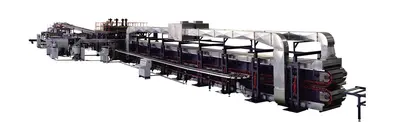
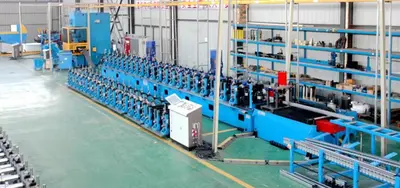
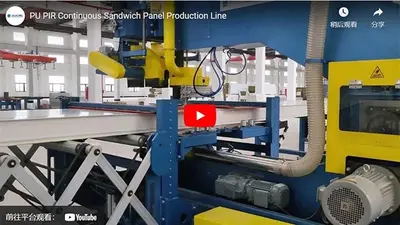
Leading manufacturers rely on proven, high-technology equipment to achieve superior density control. The PU/PIR Continuous Sandwich Panel Production Line from Jinggong exemplifies advanced engineering in this field. This fully integrated system combines precision decoiling, high-accuracy roll forming, high-pressure foaming, double-belt laminating, and automated cutting into one seamless production platform.
Jinggong’s production line features state-of-the-art metering and mixing equipment capable of maintaining chemical ratio tolerances within 0.5%. Its advanced temperature control system, coupled with servo-driven belt adjustments, enables precise regulation of foam expansion and density across a wide range of specifications. The production line supports rapid recipe changes, allowing manufacturers to switch between different densities (35–50 kg/m³) and thicknesses with minimal downtime. With production speeds adjustable from 3 to 8 m/min and high automation levels, it delivers consistent, uniform PU cores while minimizing material waste and ensuring excellent bonding to metal facings. This technology has been successfully deployed globally for producing panels used in cold storage, industrial warehouses, commercial buildings, and clean rooms, where density consistency is non-negotiable for performance and certification.
.jpg "Jinggong PU/PIR Continuous Sandwich Panel Production Line")
.jpg "Jinggong PU/PIR Continuous Sandwich Panel Production Line")
.jpg "Jinggong PU/PIR Continuous Sandwich Panel Production Line")
.jpg "Jinggong PU/PIR Continuous Sandwich Panel Production Line")
Challenges in PU Density Control
Despite advanced systems, several challenges remain:
Raw Material Variability: Batch-to-batch differences in polyol or isocyanate quality can affect reactivity.
Environmental Factors: Ambient temperature and humidity in the factory can influence foam behavior.
Edge Effects: Density may vary slightly near panel edges due to different heat dissipation rates.
Scaling Issues: Maintaining uniformity becomes more difficult at higher production speeds or wider panel dimensions.
Manufacturers address these through rigorous raw material testing, climate-controlled production halls, and periodic calibration of all sensors and pumps. Regular laboratory verification of core samples cut from finished panels provides final validation of density targets.
Benefits of Precise Density Control
Thermal Performance: Uniform density ensures predictable and optimal
lambda values, helping buildings meet energy codes.
Mechanical Reliability: Consistent density prevents weak zones that could lead to delamination or structural failure.
Material Efficiency: Tight control reduces overuse of expensive chemicals, improving profitability.
Quality Certification: Panels with documented density consistency more easily achieve CE, UL, or other international certifications.
Customer Satisfaction: End users receive reliable products with expected weight, insulation, and durability characteristics.
Future Trends in Density Control Technology
The industry is moving toward even smarter systems. AI and machine learning algorithms are being integrated to predict optimal parameters based on historical data. IoTconnectivity allows remote monitoring and predictive maintenance of critical components like metering pumps and mixing heads. Sustainable formulations using bio-based polyols and low-GWP blowing agents are also driving new density control strategies. As demand for high-performance insulated panels grows in green building and cold chain logistics, production lines that excel at density control will remain competitive.
Controlling PU density in sandwich panel production lines is a sophisticated blend of chemistry, mechanical engineering, and digital automation. From precise chemical dosing and high-pressure mixing to dynamic laminator control and real-time monitoring, every element of the production process works in harmony to achieve target density with minimal variation. Advanced solutions such as the PU/PIR Continuous Sandwich Panel Production Line by Jinggong provide manufacturers with the tools needed to produce high-quality, consistent panels efficiently. As construction standards become more demanding and sustainability requirements increase, mastery of density control will continue to distinguish leading panel producers worldwide.
Investing in modern production technology not only ensures product excellence but also drives operational efficiency and market competitiveness in the rapidly evolving building materials sector. For companies seeking reliable, high-performance PU sandwich panels, understanding and optimizing density control remains at the heart of successful manufacturing.

 CN
CN
 EN
EN
 fr
fr  de
de  es
es  it
it  ru
ru  pt
pt  ar
ar  th
th  pl
pl  ro
ro 

 Call us on:
  Email Us:
  #1809, Jianhu Rd, Keqiao, Shaoxing, Zhejiang, China