How to Choose a Rock Wool Sandwich Panel Production Line
Choosing a rock wool sandwich panel production line requires a review of target capacity, panel sizes, automation, core handling, adhesive application, cutting accuracy, and supplier support. The best line is the one that can produce repeatable panels for the buyer’s actual building applications without creating unnecessary labor, waste, or maintenance.
A rock wool sandwich panel production line bonds metal facings to a mineral-fiber core through coordinated feeding, core preparation, adhesive application, pressing, cutting, stacking, and packing. Rock wool panels are widely used for industrial walls, roofs, partitions, warehouses, logistics buildings, and prefabricated facilities where fire resistance, acoustic performance, and thermal insulation are important. Because the core is fibrous rather than foamed in place, handling and bonding stability are central to product quality.
Start With Capacity and Product Specifications
Capacity should be calculated from realistic order demand, working hours, product mix, and expected utilization. Buyers should avoid selecting a line only from the highest advertised speed. The actual output is affected by panel thickness, length, adhesive curing, profile changes, core preparation, cutting, stacking, and packing.
Before requesting a configuration, define:
Target annual and monthly output
Panel width, thickness, and length range
Wall, roof, partition, or cleanroom applications
Metal-sheet thickness and coating
Rock wool density and board dimensions
Joint profile and side-sealing requirements
Number of shifts and available operators
A rock wool sandwich panel line intended for standard industrial wall panels may need a different layout from one serving long roof panels or cleanroom partitions. Clear specifications allow the supplier to size the forming, core-feeding, pressing, cutting, and handling sections correctly.
How Automation Affects Labor and Consistency
Modern rock wool production lines may automate sheet feeding, roll forming, core transfer, adhesive spraying, side sealing, pressing, cutting, stacking, and packing. Automation can reduce manual variation, but each added section should solve a practical production problem.
The most valuable automation functions usually improve:
Rock wool strip alignment and transfer
Adhesive dosage and distribution
Line-speed coordination
Panel length measurement and cutting
Stacking accuracy and surface protection
Production recipes and fault diagnostics
A higher automation level can support repeatable quality across shifts and reduce dependence on highly experienced operators. However, buyers must also consider maintenance skills, local spare-parts availability, sensor cleanliness, and operator training. A simpler line that is well matched to the factory may outperform a highly automated line that the local team cannot maintain.
Core Handling, Bonding, and Side Sealing
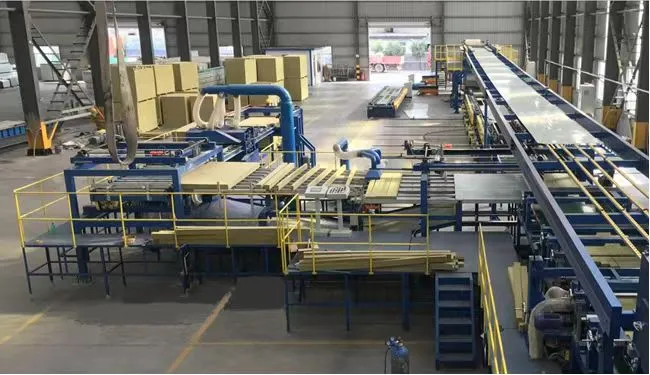
Core handling is one of the main differences between a rock wool sandwich panel machine and a foam-core panel line. Rock wool boards or strips must be prepared, oriented, transferred, aligned, and held in position before pressing. Gaps, uneven strips, or unstable feeding can cause weak areas, thickness variation, or poor panel appearance.
The adhesive system should apply a controlled amount across the required bonding area. Too little adhesive can reduce bond strength, while excessive or uneven application may increase cost and create surface defects. Buyers should review pump control, spraying uniformity, cleaning procedures, and compatibility with the selected adhesive.
Some configurations also use PU side sealing to improve edge structure or joint performance. The supplier should explain how side sealing is synchronized with core movement and metal-sheet forming. Stable bonding and edge formation reduce the risk of delamination, open joints, and installation complaints.
Quality Control Points Buyers Should Define
A mineral wool sandwich panel production line should be evaluated by finished-panel results, not only machine movement. The buyer and supplier should agree on acceptance criteria before shipment and commissioning.
Typical quality checks include:
Panel width, length, and thickness tolerance
Surface flatness and visible marks
Bond strength between core and facings
Core alignment and absence of internal gaps
Edge and joint geometry
Cutting squareness and burr condition
Stacking damage and protective-film condition
During trial production, samples should be checked at different speeds and thicknesses. The factory should also establish incoming inspection for rock wool boards, metal coils, adhesive, and protective film. Consistent raw materials make process control easier, while unstable materials can create defects even when the machinery is operating correctly.
How to Compare Suppliers and Line Configurations
Buyers comparing rock wool production lines should send the same requirement sheet to each supplier and request a detailed technical scope. The proposal should identify every machine section, component brand, utility requirement, operator requirement, installation service, warranty, and spare-parts package.
Useful questions include:
Has the supplier built a similar panel line?
What core dimensions and densities can the system handle?
How quickly can profiles or thicknesses be changed?
What is the realistic speed for the target panel?
How are adhesive application and side sealing controlled?
What acceptance tests are included?
What remote and on-site support is available after commissioning?
Reference projects, sample panels, layout drawings, and videos of continuous production can help verify capability. Buyers should also check whether the proposed workshop layout leaves enough space for raw materials, finished panels, maintenance access, and future expansion.
FAQ About Rock Wool Sandwich Panel Line Selection
What determines the capacity of a rock wool production line?
Capacity depends on line speed, panel dimensions, core preparation, adhesive curing, cutting, stacking, working hours, and product changeovers.
Is the fastest line always the best investment?
No. The suitable speed is the one that maintains bonding, dimensions, surface quality, and reliable handling for the intended products.
What automation is most important?
Core alignment, adhesive control, coordinated conveying, accurate cutting, and stable stacking usually provide the greatest quality and labor benefits.
Can one line produce several panel thicknesses?
Yes, when the pressing system, guides, forming sections, and controls support the required range. Tooling or adjustment time should be confirmed.
What should be checked during factory acceptance?
Inspect finished-panel dimensions, bonding, core placement, edge geometry, surface quality, cutting accuracy, line stability, and safety functions.
Jinggong’s rockwool continuous sandwich panel production solution integrates forming, core handling, adhesive application, side sealing, pressing, cutting, stacking, and packing. Manufacturers can provide their panel specifications and capacity target to receive a suitable configuration.

 CN
CN
 EN
EN
 fr
fr  de
de  es
es  it
it  ru
ru  pt
pt  ar
ar  th
th  pl
pl  ro
ro 

 Call us on:
  Email Us:
  #1809, Jianhu Rd, Keqiao, Shaoxing, Zhejiang, China