Tube Mill Machine Process: From Strip Entry to Welded Tube Sizing and Cutting
The tube mill machine process converts steel strip into a continuous welded tube through a sequence of forming, welding, sizing, and cutting stages. Although the finished tube may look simple, stable production depends on how each stage controls the strip before and after welding. Material thickness, strip width, forming configuration, welding conditions, and cutting accuracy all influence the final product.
For manufacturers planning a new line or comparing equipment, understanding the complete process is more useful than evaluating the welding unit alone. The following stages show where production consistency is established and what buyers should consider when specifying a tube mill.
What Happens at the Beginning of the Tube Mill Machine Process?
Production normally begins with a coil of steel strip. The strip is introduced into the line through equipment that controls unwinding and feeding before it reaches the forming section.
The basic sequence can be summarized as follows:
Coil entry → strip preparation → forming → high-frequency welding → sizing → cutting → finished tube handling
Each stage has a different function. The entry section needs to provide stable strip movement, while the forming section progressively changes the flat strip into a tubular shape. After welding creates the longitudinal seam, sizing equipment adjusts the tube toward the required final dimensions.
The actual configuration varies according to tube diameter, wall thickness, material, production speed, and product specifications. Therefore, a tube mill should be designed around the intended product range rather than treated as a universal machine.
How Does Strip Forming Prepare the Material for Welding?
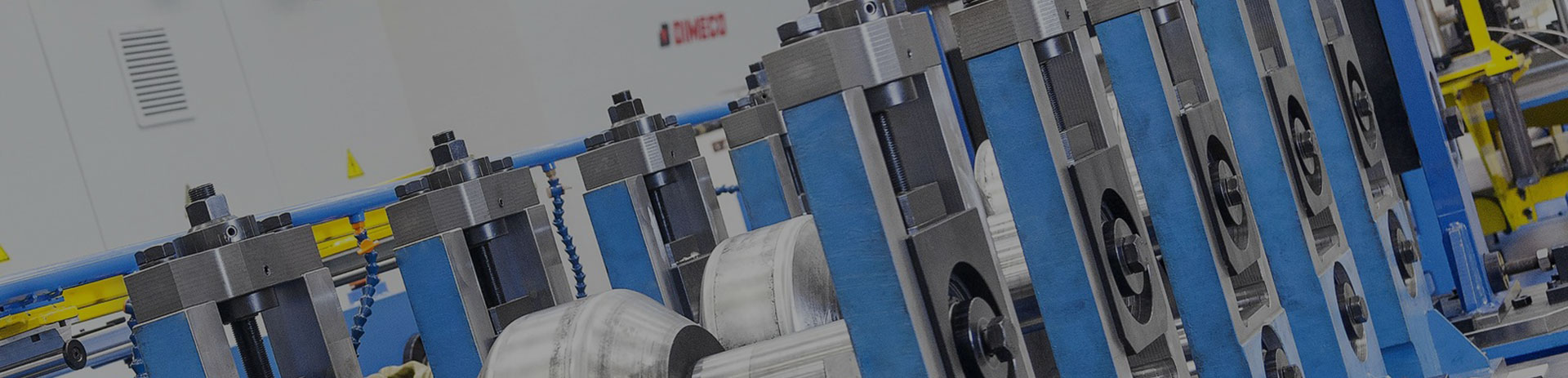
Before welding, the flat strip passes through a series of forming stands that gradually bend its edges toward each other. Progressive forming is important because aggressive deformation at one stage can create unnecessary stress, instability, or dimensional variation.
The forming process should maintain consistent strip tracking while bringing the edges into a suitable position for welding. The required forming arrangement depends on the tube diameter and material dimensions.
For example, a smaller tube generally requires a different tooling arrangement from a large-diameter product. Changes in strip thickness can also affect forming behavior. This is why buyers should provide the supplier with the complete material and tube specification before selecting equipment.
Why Is High-Frequency Welding a Critical Stage?
The welding section joins the two longitudinal edges after the strip has been formed into a tubular shape. A high frequency tube mill uses high-frequency electrical energy to heat the edges so they can be pressed together and form a continuous welded seam.
Welding stability depends on more than electrical power. The line must maintain suitable strip alignment, edge preparation, welding conditions, and tube movement. If these variables fluctuate, the seam can become inconsistent and affect downstream sizing and finished-tube quality.
For buyers evaluating a tube mill production line, it is therefore useful to ask how the welding system is coordinated with the forming and sizing sections. A well-integrated line should maintain synchronized operation rather than treating welding as an isolated component.
How Does Sizing Influence Finished Tube Dimensions?
After welding, the tube enters the sizing section. Here, forming rolls gradually adjust the welded tube toward the required outside dimensions and shape.
Sizing is particularly important when the finished tube must meet consistent dimensional requirements. The process can influence outside diameter, straightness, and the final cross-sectional geometry.
When evaluating equipment, buyers should consider:
Tube diameter range: The tooling and line configuration should correspond to the intended product sizes.
Wall thickness: Thickness affects forming load, welding conditions, and overall line requirements.
Dimensional tolerance: The required finished accuracy should be established before machine selection.
Changeover: Manufacturers producing several tube sizes should consider how tooling changes affect downtime.
Cutting requirements: Finished lengths and production speed should be coordinated with the sizing and cutting system.
JINGGONG Technology's high-frequency welded pipe mill line can be considered as part of this broader process when defining a tube production configuration.
What Should Buyers Check When Specifying a Tube Mill?
A machine quotation becomes more useful when the supplier receives complete production information. Instead of asking only for the price of a tube mill, buyers should define the products the line is expected to manufacture.
A practical specification should cover:
Tube dimensions: Provide the target outside diameter or size range.
Material: State steel type, strip width, thickness, and relevant material characteristics.
Production capacity: Define the required output and operating conditions.
Welding requirements: Clarify the expected seam-welding process and production range.
Finished length: Specify standard cutting lengths and tolerance requirements.
Product range: Explain whether one tube size or multiple sizes will be produced.
Factory conditions: Consider available floor space, electrical supply, material handling, and installation requirements.
These details help suppliers determine the appropriate forming stands, welding configuration, sizing arrangement, cutting system, and control architecture.
Conclusion: Building a Stable Tube Production Process
The tube mill machine process is a connected sequence in which each stage influences the next. Stable strip entry supports consistent forming; controlled forming prepares the edges for welding; reliable welding creates the longitudinal seam; and accurate sizing and cutting determine the final product. For manufacturers comparing a tube mill, the key is to match the complete line configuration with the intended tube range, material specifications, production target, and dimensional requirements. A detailed product specification also gives suppliers a clearer basis for engineering and quotation.
FAQ
What is a tube mill machine used for?
A tube mill forms steel strip into a tubular shape, welds the longitudinal seam, sizes the tube, and cuts it into specified lengths.
What is a high-frequency tube mill?
It is a tube production line that uses high-frequency electrical energy to heat and join the edges of the formed strip during continuous welding.
Which factors affect tube mill production speed?
Material thickness, tube diameter, forming configuration, welding conditions, sizing requirements, and cutting arrangements can all affect practical production speed.
Why is progressive forming used?
Progressive forming gradually changes the flat strip into a tubular shape, helping maintain controlled deformation and stable material movement.
What information should be included in a tube mill RFQ?
Buyers should provide tube dimensions, material specifications, production requirements, finished lengths, product range, and relevant factory conditions.
Can one tube mill produce different tube sizes?
A suitable line may support a specified range of tube sizes, but tooling and configuration requirements vary. Buyers should confirm the intended size range with the equipment supplier before ordering.

 CN
 EN
 fr
 de
 es
 it
 ru
 pt
 ar
 th
 pl
 ro


 Call us on:
 Email Us:
 #1809, Jianhu Rd, Keqiao, Shaoxing, Zhejiang, China